A JSON dashboard is a data visualization tool that parses JSON data from a REST API or file and displays it as charts, KPIs, and dashboards to help you monitor your business at a glance. JSON Dashboard from Dashboard Builder is a free, high-performance, lightweight engine, built as an intuitive zero-code & code-first builder—so it works equally well for a developer who wants to inspect the generated PHP and a business user who never wants to see it.
What Is JSON Dashboard and How Does It Work?
A JSON dashboard connects to a live data source—typically a REST API endpoint or a JSON file—and transforms that raw data into charts, KPI tiles, and visual summaries on a single, centralized screen. Instead of manually reading through raw JSON, a JSON dashboard retrieves the data in the background, maps it to a chart, and refreshes the view so you're always looking at current data.
JSON Dashboard from Dashboard Builder works this way under the hood: it's a PHP-based tool built on Apache + PHP with a free charting engine. You connect your REST API or JSON file once through a drag-and-drop interface, and the app generates the PHP/HTML5 code that renders your live charts—so the dashboard updates automatically as your underlying data changes, and you can check it from your phone, tablet, or PC.
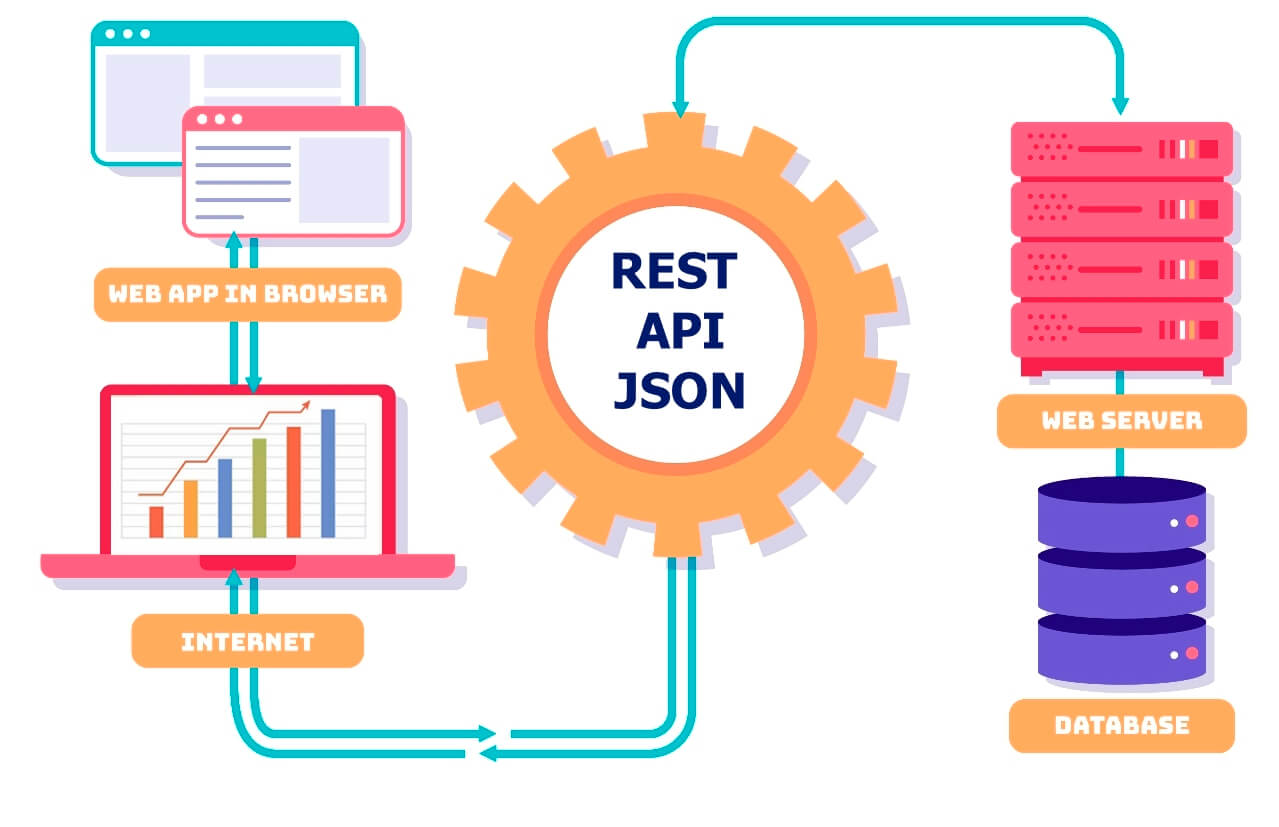
Note: JSON syntax is minimal and lightweight by design, which is exactly why JSON Dashboard is able to parse it and render charts quickly—there's no additional setup required, since JSON encode/decode ships as part of the PHP core.
How to Build a JSON Dashboard (Step-by-Step)
Building a JSON dashboard with Dashboard Builder comes down to five steps: connect your REST API or JSON file, configure your chart, assign your data columns, adjust the layout, and generate the PHP source code for your web application.
Run the dashboard builder. Access the web folder in your browser (e.g. http://localhost/dashboardbuilder), or launch the on-premises app directly.
Click the database icon. On the File tab, enter the URL of your REST API or JSON file and hit Save Changes. A green checkmark confirms it connected successfully.
Open chart properties and check your data. Click the gear icon to open chart settings. Here's a sample JSON format Dashboard Builder can parse right away:
[ { "firstName": "Joe", "lastName": "Jackson", "gender": "male", "age": 28, "number": "7349282382" }, ...]
Assign the returned fields to your X-axis and Y-axis dropdowns and save.
Adjust the position and size. Drag the corners of the chart panel to resize and reposition it. Layout is fully responsive, built on the Bootstrap framework, so your dashboard adapts to any screen automatically.
Generate your PHP source code. Click Generate, and Dashboard Builder outputs ready-to-use PHP source code for the chart you just built—copy and paste it directly into your own application.
Ready to build your own dashboard? Download JSON Dashboard for free to get started today.
Supported Chart Types & Data Sources
JSON Dashboard supports a range of chart types—including line, bar, stack, and area—all rendered as dynamic, D3.js-powered graphics that update automatically when a user clicks a trace, data legend, or chart filter. You can preview live examples in the JSON Dashboard Examples gallery.
For data, the app connects directly to any REST API endpoint that returns JSON, or to a standalone JSON file—no programming required to retrieve or parse it.
Requirements & Installation
JSON Dashboard can be installed on Windows, Linux, Mac, or any other platform that supports Apache. It runs on zero heavy server dependencies—just the core PHP and Apache stack most environments already have.
Server Requirements
- PHP Version 7 or later
- Apache 2 or later
- Windows 7 or later / Linux 3 or later
- JSON enabled (already on by default—JSON encode is part of the PHP core)
Supported Browsers
- Firefox 52 or higher
- Chrome 57 or higher
- IE, on any SVG-compatible version
Installation
- Download the free version from the download page.
- Place the files in a directory on your web server, e.g.
…/www/yoursite/dashboardbuilder-v4-FREE/. - Unzip the file using the Extract Here option to the root folder of "dashboardbuilder".
Before connecting your REST API or JSON file, make sure your web server (Apache, Nginx, etc.) is configured to serve the folder containing Dashboard Builder. Check your browser console to confirm all files load without errors.
Advantages of Using JSON Dashboard
1. Zero-Code & Code-First, Together
The drag-and-drop interface lets a business user build a working dashboard without writing a line of code, while the auto-generated PHP gives developers a clean starting point to extend.
2. Fast, Lightweight Parsing
JSON syntax is minimal by design, so JSON Dashboard parses your data and renders charts faster than heavier data formats.
3. Embed Anywhere
Export clean PHP and HTML5 code and integrate it into any PHP application, WordPress, Joomla, or Laravel site you already run.
Auto-Generated PHP Source Code
Once your chart is built, JSON Dashboard generates ready-to-use PHP source code you can drop straight into any PHP application, website, or framework—published under the MIT license, so you're free to customize it however you need.
$data = new dashboardbuilder();$data->type = "line";$data->source = "JSON";$data->url = "https://api.example.com/data.json";$data->xaxisCol[0] = "xaxis";$data->yaxisCol[0] = "yaxis";$data->title = "Line Chart";$result[0] = $data->result();
You can find the complete license details on the code license page.